Claude vs ChatGPT for Marketing: Which AI Should You Actually Use in 2026?
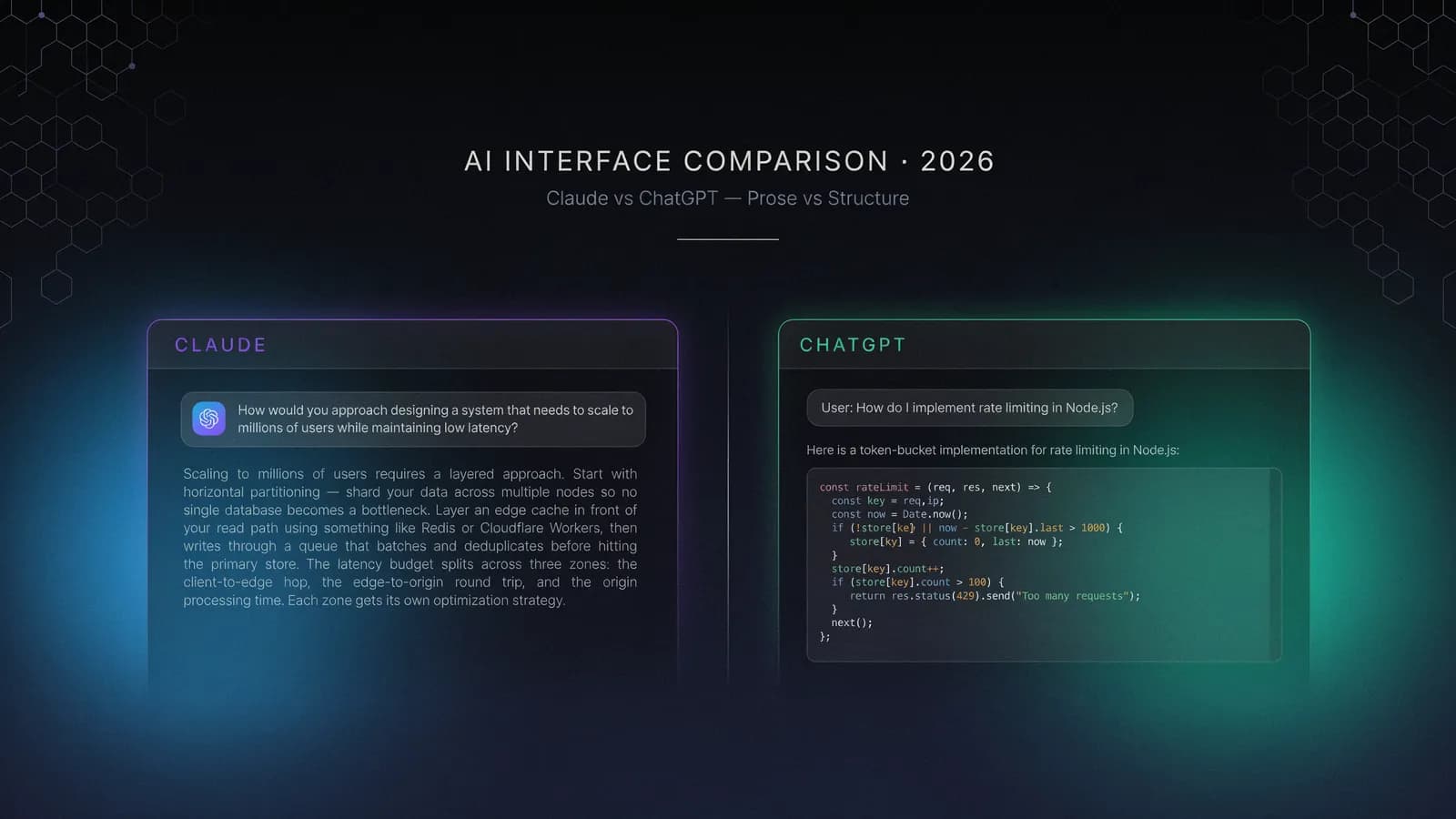
You picked one. You kept using it. Maybe it was the right call. But there is a specific type of work where that choice costs you 20 to 30 minutes every single time — and nothing in your workflow shows it.
If your team settled on one of these two tools without a systematic comparison, there's a decent chance you're spending an extra 20–30 minutes per piece undoing quirks that the other tool handles better by default. Not because you made a bad choice — the choice looks roughly equivalent from the outside. Both tools have gotten significantly better since early 2026, which makes the gap look smaller than it actually is for specific task types. The benchmarks tell one story. What happens when you run the same content brief through both tells another.
I've run both tools through the same prompts over the past several months. The gap is real, but it's narrower than most people expect. Where you land depends entirely on your workflow — and for a significant slice of users, neither tool alone covers it.
Quick Verdict
Category | Claude | ChatGPT | Winner |
|---|---|---|---|
Writing quality | Natural prose, nuanced tone | Structured, reliable | Claude |
Coding | 80.8% SWE-bench, #1 Chatbot Arena | Strong code interpreter, GPT ecosystem | Claude (benchmarks) |
Speed | Fast | Fast | Tie |
Free tier | Limited Sonnet 4.6 | Limited GPT-5 | Tie |
Paid ($20/mo) | Pro: Opus 4.6 + Claude Code | Plus: GPT-5 + DALL-E + voice | Tie (different strengths) |
Context window | 200,000 tokens | 128,000 tokens | Claude |
Image generation | None | DALL-E built-in | ChatGPT |
Integrations | Fewer third-party | 100+ GPTs, plugins | ChatGPT |
Team pricing | $25/user/mo | $30/user/mo | Claude |
Bottom line: Claude for writing, long-context reasoning, and coding quality. ChatGPT for integrations, image generation, and multi-tool workflows.

What Each Tool Is Built For
Claude comes from Anthropic, a safety-focused AI lab founded by former OpenAI researchers. The model is trained using Constitutional AI — a technique that embeds specific behavioral principles directly into training rather than just fine-tuning outputs. In practice, Claude is less likely to confidently hallucinate and more likely to say “I’m not sure” when it isn’t.
The current flagship models are Claude Opus 4.6 (most capable) and Claude Sonnet 4.6 (faster, slightly less capable). Claude’s standout spec is its 200,000-token context window — enough to process a 150,000-word document in one session. That’s roughly the length of two full-length novels. If you’re summarizing long reports, reviewing entire codebases, or maintaining context across a complex research session, nothing comes close.
ChatGPT is built by OpenAI on the GPT architecture. The current primary model is GPT-5 (GPT-4o for multimodal tasks), and what it offers beyond raw model quality is an ecosystem. DALL-E image generation is built-in. You get voice mode with real-time conversation. The GPT Store has hundreds of specialized assistants for everything from legal document review to recipe generation. And the code interpreter lets you run Python directly inside the chat — upload a CSV, get an instant analysis.
The honest difference: Claude is a better writer and a better reasoner. ChatGPT is a better platform. For most people, that distinction determines everything.
Writing Quality — Head-to-Head Test
I ran the same prompt through both tools: “Write the opening paragraph of a blog post about why most content marketing fails. Be direct, don’t start with ‘In today’s digital age.’”
Claude Sonnet 4.6 output: “Most content marketing fails not because companies write bad content, but because they write for the wrong moment. They publish when they want to publish, not when their audience is actually searching. They optimize for engagement metrics that don’t correlate with revenue. And they measure success by traffic instead of pipeline. The result is a lot of very professional-looking content that does almost nothing.”
GPT-4o output: “Content marketing has a dirty secret: most of it doesn’t work. Companies spend thousands producing blog posts, whitepapers, and case studies that generate clicks but not customers. The problem isn’t quality — it’s strategy. Without a clear connection between content and buyer intent, even the best-written piece gets lost in the noise.”
Both are competent. But look at what Claude does differently: it specifies four separate failure modes with concrete cause-effect logic. The GPT-4o version is tighter and punchier, but it’s also vaguer — “gets lost in the noise” tells you nothing actionable.
For AI content creation in a marketing context, Claude’s natural tendency to build structured arguments makes it significantly more useful for blog drafts, executive summaries, and anything that needs to hold a reader’s attention beyond 300 words.
Verdict: Claude wins writing quality, particularly for long-form, nuanced prose. ChatGPT is better for quick brainstorming, bullet lists, and situations where speed matters more than depth.
Coding & Technical Tasks
This is where the data gets interesting — and where most comparison articles get it wrong.
The common assumption is that ChatGPT wins on coding because it has code interpreter. That’s backwards. Claude leads on every major coding benchmark:
- Claude Opus 4.6: 80.8% on SWE-bench Verified — the industry standard benchmark for autonomous software engineering tasks
- Claude Sonnet 4.6: 79.6% on SWE-bench Verified
- Claude Opus 4.6 holds the #1 spot on Chatbot Arena’s coding leaderboard with an Elo score of 1,561
- In blind quality tests, Claude Code produces better code 67% of the time compared to Codex CLI
I ran a practical test: debugging a Python script with a subtle logic error in a recursive function. The error wasn’t a syntax mistake — it was a wrong base case that would only surface with certain inputs.
Claude identified the exact line, explained why the base case failed, provided a corrected version, and added a note about an edge case I hadn’t asked about. GPT-4o found the bug too, but suggested a workaround rather than fixing the underlying logic.
ChatGPT’s advantage is the code interpreter: you can upload a file, run code, and see outputs inside the chat. For data analysis, quick scripts, and iterative testing without a local environment, that’s a real advantage. Claude’s equivalent is Claude Code — a terminal-based coding agent included free with Claude Pro — which is more powerful but requires setup.
Verdict: Claude wins on raw coding quality. ChatGPT wins on in-chat code execution. If you code professionally, the benchmark gap matters. If you occasionally write scripts, ChatGPT’s integrated interpreter is more convenient.
Pricing — Free vs Paid
Both tools offer free tiers. Both charge $20/month at their standard paid tier. The differences are at the premium and team levels.
Current Plans (June 2026)
ChatGPT
Tier | Price | What you get |
|---|---|---|
Free | $0 | Limited GPT-5 access, basic features |
Plus | $20/mo | Full GPT-5, DALL-E image gen, voice mode, web browsing, 100+ GPTs |
Pro | $200/mo | Unlimited GPT-5, o3 access, priority compute |
Team | $30/user/mo | Plus features + admin controls, team workspaces |
Claude
Tier | Price | What you get |
|---|---|---|
Free | $0 | Limited Sonnet 4.6 access |
Pro | $20/mo | Opus 4.6, Sonnet 4.6, Claude Code terminal agent included |
Max | $100/mo | Higher usage limits on all models |
Team | $25/user/mo | Pro features + admin controls, team workspaces |
Key pricing callouts:
- At $20/mo, Claude Pro gives you Opus 4.6 (their top model). ChatGPT Plus gives you GPT-5 but caps usage. That’s a meaningful difference — you’re getting top-tier access for the same price with Claude.
- Claude Team is $5/user cheaper than ChatGPT Team ($25 vs $30). For a 10-person marketing team, that’s $600/year.
- ChatGPT Pro ($200/mo) is twice Claude Max ($100/mo). If you’re a heavy power user who hits limits, Claude is more economical.
- Claude Code is included free in Claude Pro. GPT’s equivalent code interpreter is a Plus feature, but a proper coding agent in ChatGPT’s vein would require separate tooling.

Verdict: Neither is clearly cheaper at $20/mo. At higher tiers, Claude wins on value. Teams should factor in the $5/user monthly difference.
Which One Is Right for You?
Here’s a practical decision tree based on primary use case:
You write a lot of long-form content (articles, reports, emails): → Claude. The writing quality gap is real and consistent. Your editing time goes down.
You write code professionally or debug regularly: → Claude. The benchmark advantage is meaningful. Opus 4.6’s 80.8% SWE-bench score isn’t just a number — it translates to fewer incorrect suggestions and less debugging time.
You need image generation built into your chat workflow: → ChatGPT. DALL-E integration is genuinely useful for quick mockups, social graphics, and visual ideation without switching tools.
You want to connect AI to other tools (Zapier, CRMs, productivity apps): → ChatGPT. The GPT ecosystem and API integration options are broader.
You work with very long documents (legal contracts, research papers, full codebases): → Claude. 200K context window vs 128K is a meaningful advantage for document-heavy workflows.
You’re a marketing team that needs SEO, content, campaigns, and analytics: → Keep reading the next section.
The Alternative Worth Knowing: Allable.ai
Claude and ChatGPT are both general-purpose AI assistants. Neither is designed for the end-to-end marketing workflow — keyword research, content optimization, campaign management, analytics, and reporting in one place.
That’s the gap Allable.ai fills. It combines AI chat with purpose-built marketing modules: SEO keyword research, on-page optimization, Google Ads campaign tools, content creation, and performance analytics. Instead of copying outputs from Claude into your SEO tool into your CMS, the workflow is integrated. If you use AI primarily for marketing tasks, Allable is worth testing before committing to a $20/month general-purpose tool that will leave you jumping between tabs anyway.
For a broader overview of what AI can do in the SEO space, see our guide to best AI SEO tools and the full breakdown of AI content creation workflows.
FAQs
Is Claude better than ChatGPT for writing?
Yes, in most professional writing scenarios. Claude produces more natural prose with better tone consistency and stronger logical structure. In direct comparisons using the same prompts, Claude outputs typically require less editing before publication — particularly for long-form articles, marketing copy, and executive-level communications. ChatGPT is better for quick drafts, brainstorming, and structured content at scale where speed is the priority.
Which is cheaper, Claude Pro or ChatGPT Plus?
At the $20/month entry tier, they cost exactly the same. Claude Pro gives you access to Opus 4.6 (their top model), while ChatGPT Plus gives GPT-5 with some usage caps. At higher tiers, Claude is more affordable: Claude Max is $100/month versus ChatGPT Pro at $200/month. For teams, Claude Team ($25/user/mo) costs $5 less per seat than ChatGPT Team ($30/user/mo).
Can I use Claude or ChatGPT for SEO?
Both can help with SEO tasks like writing meta descriptions, generating title tag variants, drafting content outlines, and suggesting internal linking opportunities. Neither has live search data, keyword volume metrics, or ranking analysis built in. For serious SEO work — keyword research, competitor gap analysis, content briefs with actual volume data — you need a dedicated SEO platform. Our roundup of best AI SEO tools covers the options that actually move rankings, and you can compare the Jasper review if you’re specifically looking at AI writing tools for SEO content.