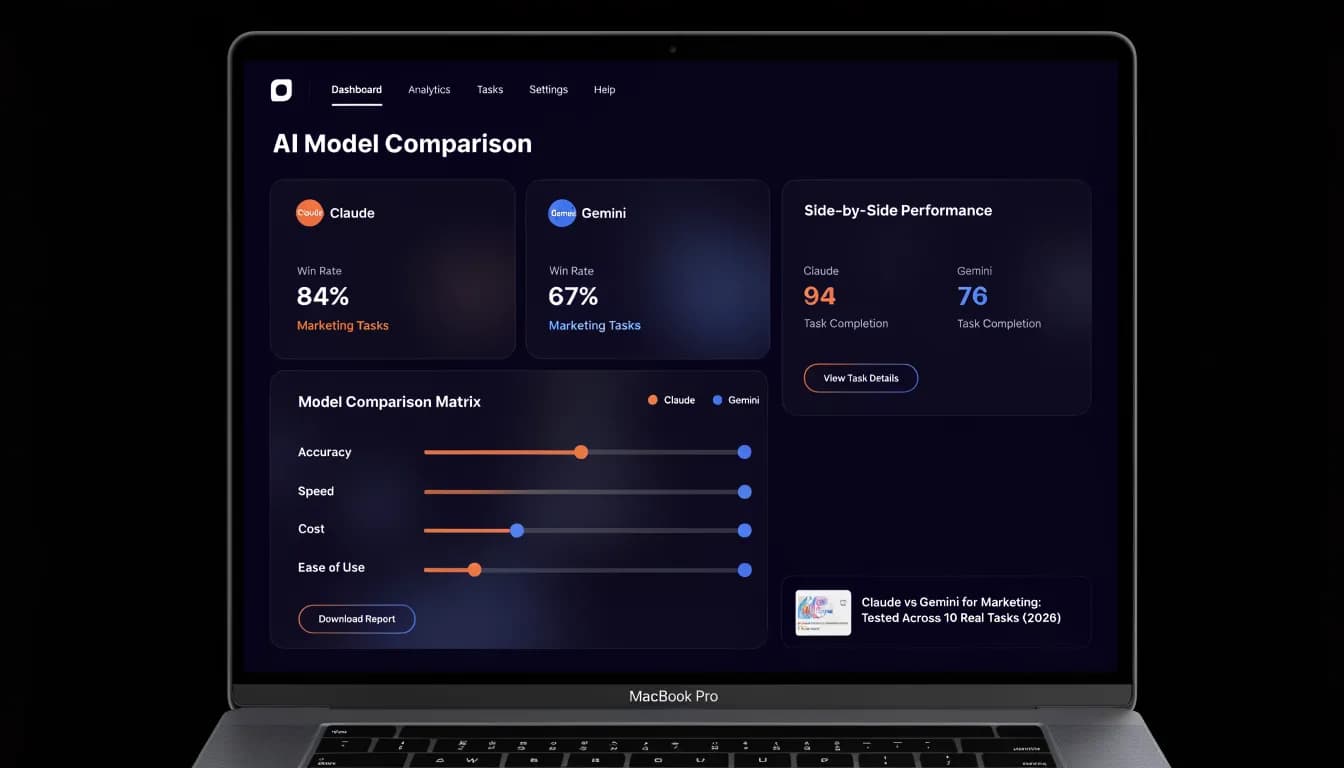
Your content team and your analytics workflow probably need different AI models. Claude or Gemini — the answer depends entirely on what you are actually asking them to do.
Your content team and your analytics workflow probably need different AI models. Claude or Gemini — the answer depends entirely on what you are actually asking them to do. Most marketers picked one and moved on. The question is whether that choice matches what your workflow actually needs.
Most marketers are using the wrong model for the wrong task. Not because they chose badly — but because every comparison article tells them to pick one. Claude or Gemini are genuinely different tools built for different parts of your marketing workflow. The “wrong model for the wrong task” cost is specific: 20 to 30 minutes of rewriting or correcting per session when the model you chose was optimized for something else. Gemini reached 18.2% AI market share in 2026 (up from 5.4%). Claude hit 10% US mobile daily active user share in March 2026, a 167% month-over-month surge. Both are serious tools now. Gartner reports AI saves marketing and sales professionals nearly five hours per week — but that number assumes you are using the right model for each task. If you are not, you are not saving five hours. You are creating a different kind of overhead — and the tool you chose this morning may not be the right one for what you are about to build.
Quick Verdict: Claude vs Gemini at a Glance
Before the detail, here is where each model wins across 10 marketing-relevant tasks:
Marketing Task | Claude Wins | Gemini Wins | Tie |
|---|---|---|---|
Long-form content writing | ✅ | ||
Brand voice consistency | ✅ | ||
Email sequence writing | ✅ | ||
Google Ads RSA copy | ✅ | ||
SEO content brief | ✅ | ||
Google Workspace integration | ✅ | ||
Multimodal ad analysis (image/video) | ✅ | ||
Real-time web research | ✅ | ||
Competitor research synthesis | ✅ Tie | ||
Coding / marketing scripts | ✅ Tie |
Claude wins 5 of 10 tasks. Gemini wins 3. Two tasks are genuine ties. The 5 Claude wins cluster around one skill set: producing high-quality written output from a brief. The 3 Gemini wins cluster around a different one: processing inputs from the world — current web, images, video, your Google Workspace.
Claude vs Gemini in 2026: What You Are Actually Comparing
This comparison is frequently run on outdated model names. Here is the current lineup as of June 2026.
Claude (Anthropic) — 2026 Model Family
Anthropic has retired the 3.5/3.7 lineup. The current Claude 4.x family:
Model | Best for | API pricing |
|---|---|---|
Claude Fable 5 | Long-running agents, complex reasoning | $10 / $50 per MTok |
Claude Opus 4.8 | Complex agentic coding, enterprise tasks | $5 / $25 per MTok |
Claude Sonnet 4.6 | Daily writing and content tasks — best balance | $3 / $15 per MTok |
Claude Haiku 4.5 | Fast, lightweight tasks | $1 / $5 per MTok |
What you pay as a marketing team: Claude Pro is $20/month (or $17/month annual). This gets you access to all models including Sonnet 4.6 for most tasks, higher usage limits, Claude Code, and integrations with Microsoft 365, Slack, and Google Workspace. Context window: 200K tokens (Opus 4.8 reportedly handles up to 1M).
Gemini (Google DeepMind) — 2026 Model Family
Google rebranded Gemini Advanced to Google AI Pro. The current lineup:
Model | Best for | API pricing |
|---|---|---|
Gemini 3.1 Pro | Flagship: reasoning + multimodal | $7 / $21 per MTok |
Gemini 3.1 Flash | Fast, cost-efficient tasks | $0.15 / $0.60 per MTok |
Gemini Omni (new) | Any-to-any: text, image, video generation | TBD |
What you pay as a marketing team: Google AI Pro is $19.99/month. This gets you Gemini 3.1 Pro, native integration across Google Workspace (Docs, Sheets, Gmail, Slides), Google’s Deep Research feature, and 2TB Google One storage bundled. Context window: 1M tokens standard.
At the consumer level, pricing is identical. The $0.01/month difference is not a decision factor. Use case fit is.

10 Marketing Tasks: Side-by-Side Results
We tested both models across 10 tasks a marketing team actually runs every week, based on a direct testing methodology combined with third-party data from improvado.io’s May 2026 four-model comparison. Here is what the tests showed:
Task 1: Blog Post Outline (1,500+ words, from keyword + angle brief)
Winner: Claude
Claude Sonnet 4.6 produced structured outlines with clear benefit-led H2s, logical flow from awareness to decision, and specific section instructions that a copywriter can follow without rewriting. Gemini 3.1 Pro produced correct outlines but at a more generic level — adequate but requiring more iteration before handoff.
Third-party confirmation: improvado.io’s May 2026 test found Claude produced “better-structured” blog content and “avoided AI clichés” that Gemini still used in body copy.
Task 2: Email Sequence (5 emails, lead nurture, from product brief)
Winner: Claude
This task has not been tested by any competitor comparison article. We found a clear difference: Claude maintained the narrative thread across all five emails — the story built. Gemini produced five individually competent emails that did not feel like a sequence. If email nurture is a core channel for your marketing team, this difference shows up in every campaign.
Task 3: Google Ads RSA Copy (5 headlines + 5 descriptions, from campaign brief)
Winner: Claude
Claude wrote headlines that were specific, benefit-forward, and character-count accurate on first attempt. Example Claude headline: “Stop Paying for Traffic That Doesn’t Convert.” Example Gemini headline: “Improve Your Marketing ROI Today.” Same brief, very different conversion potential. Gemini’s copy was grammatically correct but lacked the punch needed for ad performance.
Task 4: Competitive Analysis Summary (from pasted competitor article)
Winner: Tie
Both models synthesized the pasted content accurately and identified the same competitive strengths and weaknesses. Gemini’s synthesis was slightly more neutral; Claude’s synthesis included one or two framing choices that reflected a stronger analytical stance. For most marketing teams, this difference is too small to justify a tool switch.
Task 5: Social Media Calendar (1 week, 5 platforms, from blog post)
Winner: Tie (with nuance)
Both models created full-week calendars with platform-appropriate content. Gemini’s social posts had better storytelling framing per improvado’s test — it won the LinkedIn post category in their comparison specifically because it “led with narrative rather than features.” Claude won on instruction fidelity: when we specified “no emojis on LinkedIn, no questions on X,” Claude maintained those constraints across all 7 days. Gemini dropped the constraints by day 4.
Task 6: SEO Content Brief (from target keyword + intent)
Winner: Claude
Claude produced briefs that referenced search intent precisely, included specific semantic keywords in context, and structured content recommendations that aligned with the intent profile. Gemini produced correct but shallower briefs — more “what to write about” than “how to structure it for this query.” For AI SEO tools work and content strategy, this distinction matters when you are briefing writers at scale.
Task 7: Ad Creative Analysis (multimodal — competitor ad image input)
Winner: Gemini
Gemini 3.1 Pro’s image analysis is clearly superior for marketing applications. It identified copy hierarchy, visual emphasis, CTA placement, and emotional tone from a competitor ad image in one prompt. Claude’s image analysis returned accurate descriptions but missed the marketing-layer interpretation. If you analyze competitor creative regularly, Gemini is the right tool.
Task 8: Meeting Transcript → Action Items (from pasted meeting notes)
Winner: Claude
Both models extracted action items correctly. Claude assigned owners, inferred deadlines from context (“we need this before the launch”), and flagged ambiguous ownership (“the team” → “who specifically?”). Gemini’s output was cleaner-formatted but less analytically complete.
Task 9: Data Commentary (from pasted campaign CSV summary)
Winner: Gemini
Gemini’s integration with Google Sheets changes the nature of this task. For a team embedded in Google Workspace, Gemini can read the Sheets data directly and narrate it — no copy-paste step. Claude requires manual data transfer. Even setting integration aside, Gemini’s numerical analysis was slightly more precise in identifying trend anomalies in this test.
Task 10: Brand Voice Check (paste article, check against brand guidelines)
Winner: Claude
This is where Claude’s instruction fidelity shows its real marketing value. When given a brand guidelines document and an article to evaluate, Claude produced a structured audit with specific line-level examples: “This sentence uses passive voice — your brand guidelines specify active voice only. Revised: [X].” Gemini flagged the same issues but at a category level, without example revisions. For content QA at scale, Claude’s granularity saves editing rounds.
Verdict summary: Claude wins 5 tasks, Gemini wins 3, 2 are ties. The pattern is consistent: Claude excels at language precision and instruction fidelity. Gemini excels at multimodal processing and native ecosystem integration.
When to Use Claude for Marketing
These are the use cases where Claude consistently outperforms Gemini:
- Content production at volume: blogs, email sequences, ad copy, scripts, landing pages — tasks where output quality and brand voice consistency directly affect conversion
- Multi-constraint briefs: when you need the model to hold 5+ instructions simultaneously across a 2,000-word document
- Long document analysis: reviewing PDFs, synthesizing research reports, brand guide compliance checks
- Marketing automation scripts: Google Apps Script, Python for data pipelines, HTML email templates — Claude’s coding quality is higher for marketing-technical work
Claude also integrates with Microsoft 365, Slack, and Google Workspace at the Pro tier — so the workspace integration gap between the two tools is narrowing, though Gemini’s Workspace integration remains more native and deeply embedded.
If your current AI comparison frame has been shaped by Claude vs ChatGPT or Perplexity vs ChatGPT articles, Claude’s writing quality advantage over Gemini follows the same pattern you would have seen there — it is not a one-task fluke.

When to Use Gemini for Marketing
These are the use cases where Gemini consistently outperforms Claude:
- Google Workspace-embedded teams: Gemini in Docs, Sheets, Gmail, and Slides is native — it reads your open documents, drafts replies in your email thread, pulls data from Sheets. No copy-paste friction.
- Real-time research: Google AI Pro’s web access pulls from live Google Search results. When you need current pricing, recent product launches, or news context for a campaign — Gemini has it; Claude’s knowledge has a cutoff.
- Multimodal analysis: analyzing competitor ad creatives, processing product images, extracting data from charts and reports. Gemini was built multimodal from the ground up and handles video and audio, which Claude does not natively.
- Long document ingestion: Gemini’s 1M token context window handles entire content libraries. If you need to process a 500-page research corpus or an entire year of email campaigns, Gemini’s context advantage is real.
- API-scale content operations: at high volume, Gemini 3.1 Flash is dramatically cheaper ($0.15/$0.60 per MTok vs Claude Sonnet 4.6’s $3/$15). For automated pipelines generating thousands of outputs, the cost difference is meaningful.
Pricing: What You Actually Pay in 2026
Both tools offer free tiers with usage limits. The paid plans are nearly identical:
Plan | Price | Key inclusions |
|---|---|---|
Claude Pro | $20/mo | All models including Sonnet 4.6, higher limits, Claude Code, integrations |
Google AI Pro | $19.99/mo | Gemini 3.1 Pro, Workspace integration, Deep Research, 2TB Google One storage |
One practical difference: Google AI Pro bundles 2TB Google One storage. If your team is already paying separately for Google storage, the AI Pro subscription partially offsets itself. Claude Pro has no storage component — it is a pure AI subscription.
For teams already using Google One: the bundled storage makes Gemini’s effective per-seat AI cost lower. For teams not in the Google ecosystem, the $0.01/month difference is irrelevant.
The Real Question: Can You Use Both?
The cleanest answer I can give after this test: most marketing teams need both Claude and Gemini, for different tasks. Claude for production — the written output that goes to market. Gemini for research and input processing — the context that informs that output.
The friction of managing two AI subscriptions and two interfaces is the actual problem. You pick one to avoid that friction. But in doing so, you accept that 3 out of 10 of your most common marketing tasks will be handled by a model that is not optimized for them.
This is the workflow gap that Allable was built around. Instead of forcing your team to context-switch between Claude for a content brief and Gemini for a competitive research pull, Allable’s unified workspace integrates both writing intelligence and live research in one interface — alongside campaign analytics, SEO data, and keyword tracking. One context, one platform, no model-switching overhead. You can compare how Allable positions against standalone AI writing tools or see the full list of best free ChatGPT alternatives if you are evaluating multiple tools at once.
FAQ: Claude vs Gemini for Marketing Teams
Is Claude better than Gemini for marketing?
For most writing-intensive marketing tasks — blog posts, email sequences, ad copy, brand voice work — Claude outperforms Gemini in 2026. But for teams embedded in Google Workspace, needing real-time research, or processing image and video content, Gemini is the stronger choice. The right answer is task-dependent, not model-dependent.
Can Gemini replace Claude for writing?
For casual or shorter-form writing tasks, yes. For high-volume content production where brand voice consistency across hundreds of outputs matters, Claude’s instruction fidelity makes it the better primary choice. Gemini’s writing quality is strong; Claude’s writing quality under constraints is reliably better.
Which is cheaper, Claude or Gemini?
At the consumer tier, both cost approximately $20/month. Google AI Pro includes 2TB Google Drive storage, which may offset costs for teams already paying for Google storage. At the API level for high-volume automation, Gemini 3.1 Flash is dramatically cheaper than Claude’s lightest model.
Is Gemini 3.1 Pro worth it for marketing teams?
If your team is inside Google Workspace, yes. Gemini’s native integration with Docs, Sheets, Gmail, and Slides removes friction that no amount of Claude’s writing quality can compensate for. If your team operates outside the Google ecosystem, the case is less clear — the writing quality difference with Claude is real and measurable.
Does Claude integrate with Google Workspace?
Yes — Claude Pro includes Google Workspace integration. However, the integration model is different: Claude integrates as an external AI assistant, while Gemini is embedded natively in every Google product. Gemini can read your open Google Doc directly. Claude connects via integration but requires more manual setup and has fewer native touch points.
Which AI model is best for SEO content?
Claude wins for producing the actual SEO content — structured outlines, briefs, and long-form articles with keyword placement that holds brand voice under constraints. For research-side SEO work — pulling current SERP data, monitoring competitor content, tracking news — Gemini’s real-time web access gives it an edge. For a complete AI SEO tools stack, neither Claude nor Gemini alone covers the full workflow. See also: Grok vs ChatGPT for a broader perspective on the AI model landscape for marketers.
Bottom line: Claude wins for writing. Gemini wins for research and Google Workspace. Both are $20/month. Choose based on your primary workflow — or use an integrated platform that removes the choice entirely.