What Is Agentic Marketing? How Autonomous AI Runs Your Campaigns in 2026
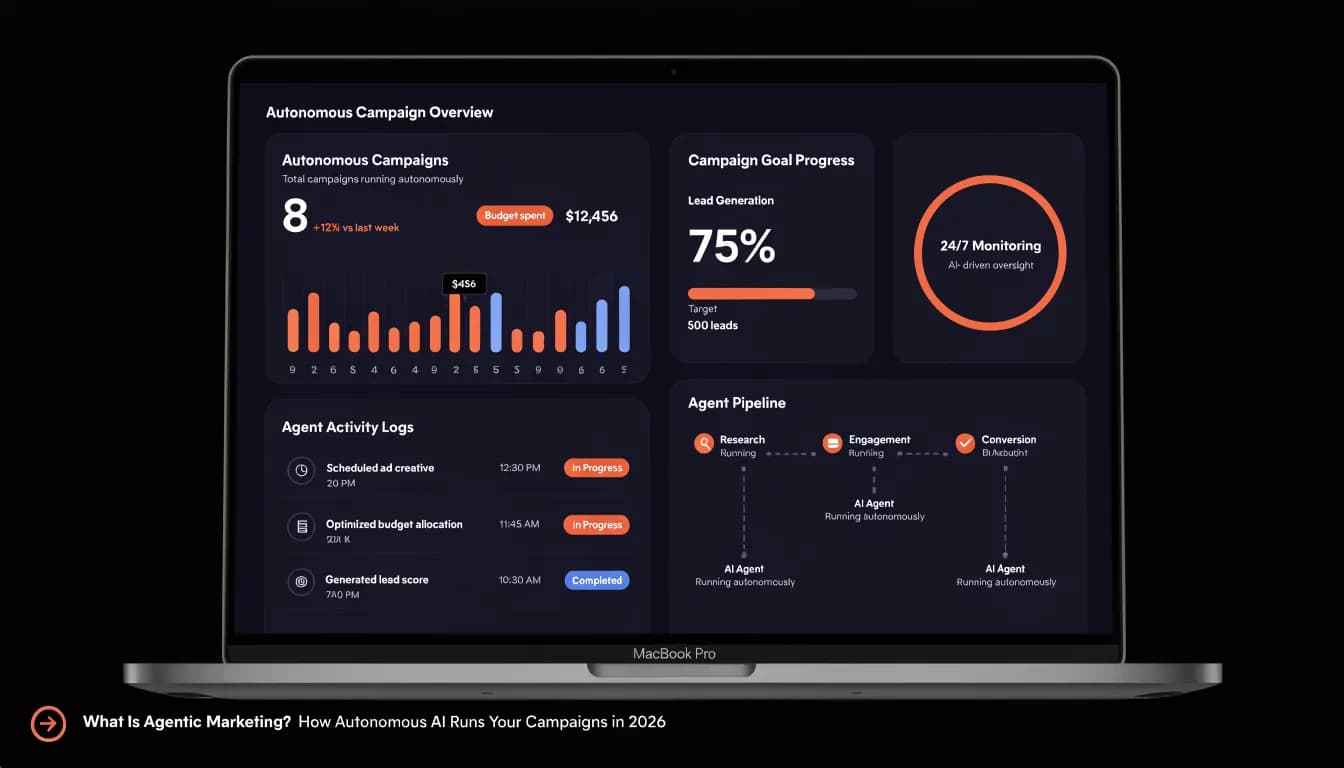
You've automated email sequences and scheduled social posts. Agentic marketing is a different category. Your next campaign might run, test, and optimize itself — without you approving every step.
Your marketing stack already does things automatically. Emails go out on schedule. Reports generate themselves. Retargeting pixels fire when visitors leave. You call that automation, and it is — but it is the old kind. Reactive, rule-based, dependent on instructions you wrote last quarter.
Agentic marketing works differently. AI agents inside your pipeline are already making decisions right now. In systems built by your competitors, AI marketing agents are adjusting bids, rewriting underperforming content, and shifting budget mid-campaign — without a human reviewing each action. If your definition of "AI in marketing" still means a writing assistant you open in a browser tab, your pipeline is already two years behind. The real question is not whether AI agents belong in your marketing. It is how much of your current pipeline can run without you — and what is stopping the rest.
Agentic Marketing — A Clear Definition
Agentic marketing is the use of AI marketing agents that execute marketing tasks autonomously — researching, planning, creating, and publishing — based on a goal you set, not a prompt sequence you manage step by step.
The word "agentic" comes directly from AI research. An agentic AI system can perceive its environment, set sub-goals, take actions, and adapt based on results — without waiting for a human instruction at every step. Applied to marketing, that means an agent can receive a goal like "increase organic traffic from this cluster by 20%" and then determine on its own what actions to take: which articles need refreshing, which keywords to target, which internal links to add, and which pages to recommend for consolidation.
This is the key distinction from regular AI marketing:
- Regular AI marketing = AI assists a human. You write the brief. AI writes the copy. You review it and prompt again.
- Agentic marketing = AI takes a goal and executes the full workflow. You review the output.
The loop: Human sets goal → Agent researches → Agent creates → Agent executes → Human reviews → Feedback loops back.
The "agentic" label is not marketing jargon. It is a technical description of what separates a ChatGPT prompt from a system that can run your AI content creation pipeline end-to-end.
Agentic Marketing vs. Traditional AI Marketing — The Core Difference
Most marketing teams are somewhere on a spectrum between "we use AI as a writing tool" and "our campaigns run themselves." Agentic marketing sits at the far right of that spectrum — but it is not a binary. Understanding the differences helps you figure out where to start.
Traditional AI Marketing | Agentic Marketing | |
|---|---|---|
Input | Prompt per task | Goal per campaign |
Human role | Directs each step | Reviews outputs |
Tools used | One tool per task | Platform orchestrates multiple |
Campaign speed | Sequential (days) | Parallel (hours) |
Error handling | Manual (you notice, you fix) | Agent self-corrects within bounds |
Team size needed | 3–5 people per workflow | 1 person + platform |
Adapts when data changes | Never (until you update the rule) | Continuously |
Salesforce research from 2024 found that 68% of marketers say manual campaign management is their biggest workflow bottleneck. Agentic systems are a direct answer to that specific problem — not by adding more automation rules, but by removing the requirement that humans write every rule in the first place.
Gartner projects that by 2026, 40% of enterprise marketing teams will deploy AI agents for routine campaign execution. The productivity gap is already too large to ignore.
How Agentic Marketing Works: The 4-Layer Stack
Whether you build agentic systems in n8n, run them through Allable, or assemble them with custom code, the architecture follows four consistent layers.
Layer 1: Perception
The agent reads your environment continuously. Traffic data, keyword rankings, ad performance, social engagement, competitor moves, email open rates. It does not wait for you to pull a report. It monitors and flags anomalies — a content piece dropping from position 4 to position 11, a campaign with declining CTR, a competitor article appearing for a keyword you own.
Layer 2: Planning
Based on what it perceives, the AI marketing agent identifies which action would move the goal forward. This is the layer most marketing automation tools skip entirely. The agent chooses between options: rewrite the intro, shift the budget, pause the underperforming ad set, or escalate to a human because the decision is outside its confidence threshold.
Layer 3: Execution
The agent acts. It rewrites the content. It adjusts the bid. It creates an A/B test variant. It sends a brief to a specialized sub-agent that handles SEO metadata. Forrester research from 2025 found that companies using AI agents in marketing reported 31% faster campaign launch times compared to teams using traditional automation.
Layer 4: Learning
The agent registers the outcome. Did the rewrite improve rankings? Did the bid adjustment lower CPA? This feedback loop is what makes agentic systems compound over time. Every action generates data. Every data point sharpens the next decision.
These four layers run in a continuous cycle. Your involvement shifts from managing every step to setting goals, reviewing outputs, and handling the edge cases the agent cannot resolve.
What Does Agentic Marketing Actually Do? 10 Real Use Cases
These are not hypotheticals. They are specific workflows where agentic systems operate today.
- Research — Agent scrapes competitor pricing pages daily, flags changes, and sends a structured digest. Your team sees a summary, not a raw crawl.
- SEO — Agent monitors your keyword rankings, identifies content decay, and generates a refresh brief with gap analysis. You get a prioritized action list, not a data dump.
- Content — Agent writes and optimizes a blog post from a target keyword, applying your brand voice and internal link structure. Your editor reviews, not writes from scratch.
- Social — Agent generates a 30-day social calendar from your content pillars and brand voice guidelines. You approve the calendar, not each individual post.
- Email — Agent segments your list by engagement signal, writes sequences per segment, and A/B tests subject lines. You review the winning variant, not every draft.
- PPC — Agent builds a Google Ads campaign from a product brief: ad groups, keywords, match types, ad copy variants. You review the structure before activation.
- Analytics — Agent monitors your core KPIs hourly, flags anomalies (CTR drop, ranking shift, cost spike), and recommends a specific action for each flag.
- Competitor intelligence — Agent monitors competitor blog updates, pricing changes, and new feature announcements. You receive a structured weekly digest, not a bookmark folder to check manually.
- Reporting — Agent compiles cross-channel weekly performance into a structured report with trend lines and variance explanations. No analyst time required for the assembly layer.
- Campaign orchestration — Agent runs a full 4-week product launch end-to-end: builds the brief, writes the content, sets up the ad campaign, schedules social posts, monitors performance, and flags for human review at each approval gate.
McKinsey estimated in 2024 that autonomous AI execution could unlock $463 billion in annual marketing efficiency gains. The bottleneck is not the technology — it is the setup cost of building these workflows. Platforms that make the setup accessible are what close the enterprise-SMB gap.
Vibe Marketing vs. Agentic Marketing — Know the Difference
These two terms are appearing together often enough that they get conflated. They describe different things.
Vibe marketing is a philosophy — an AI-first, prompt-driven approach to how marketers work. It describes the mindset: move fast, iterate constantly, use AI to generate and test ideas at a pace that was not possible before. Vibe marketers treat AI as a creative partner in every step of their process.
Agentic marketing is an architecture — it describes how AI executes campaigns autonomously. The agent does not just assist you with a task. It takes a goal and executes the workflow, including the steps you would normally handle yourself.
The overlap: both reject the model of "AI as a typing assistant you use to generate a first draft." Both assume AI is embedded in the actual workflow, not bolted on as a convenience feature.
The practical distinction: vibe marketing changes how you work. Agentic marketing changes what the system does while you are not working.
Allable operates at both layers — a prompt-driven UX that makes execution fast (vibe layer) with autonomous agents running behind each task (agentic layer). If you have not already read the overview of Allable's AI marketing strategy, that is the practical context for how these two layers interact.
The Agentic Marketing Stack — From Enterprise to Accessible
The reason most articles on agentic marketing feel irrelevant to non-enterprise teams is that they describe enterprise budgets. Here is the full spectrum.
Enterprise agentic stack ($5,000–50,000+/mo)
Salesforce Agentforce + Marketing Cloud, McKinsey Lilli, Braze AI agents. These systems are deeply capable. They are also built for organizations with dedicated AI teams, six-month implementation timelines, and seven-figure software budgets. If you are reading this article, this is probably not your tier.
Mid-market agentic stack ($150–2,000/mo)
n8n, Make.com, or Dify combined with Claude or GPT-4 API access, plus custom workflow logic. This approach gives you full architectural control. It requires 15–20 hours of initial setup, comfort working with APIs and JSON, and ongoing maintenance as models and APIs change. Copy.ai's GTM AI sits in this tier for sales-focused workflows. Capable — if your team has the technical fluency.
Accessible agentic stack ($50–300/mo)
Purpose-built marketing platforms where the agentic architecture is already assembled. No workflow coding, no API keys, no dev sprint to schedule. You set the goal; the platform handles execution.
Platform | Setup Time | Monthly Cost | Marketing-Native | No-Code | Multi-Channel |
|---|---|---|---|---|---|
Salesforce Agentforce | 6 months | $5,000+ | Yes | No (requires dev) | Yes |
n8n + Claude API | 15–20h | $150–400 | No (DIY build) | No | Yes with config |
Copy.ai GTM AI | 2–4h | $500+ | Partial (GTM/sales) | Yes | No (sales-focus) |
Make.com + AI | 5–10h | $100–300 | No (generic) | Partial | Yes with config |
Allable | <5 min | From $49 | Yes (built for marketing) | Yes | Yes |
Allable is an agentic marketing platform built specifically for the accessible tier. The 4-layer stack — perception, planning, execution, learning — is pre-assembled for the channels marketing teams actually use: SEO, content, paid media, social, analytics. If you want to explore what the AI SEO tools layer looks like in practice, that is the clearest concrete starting point.
How to Start with Agentic Marketing — A 4-Step Framework
You do not need to rebuild your entire stack. The most productive entry point is one specific bottleneck where an agent can operate with clean data, a clear goal, and a defined decision boundary.
Step 1: Map your highest-repetition marketing workflows
List every task your team performs weekly that has a clear input, a clear output, and a metric you already track. A solid content marketing strategy is the best foundation for deciding which workflows to hand to an agent first. Content refreshes, ad performance reviews, competitor monitoring, weekly reporting. These are agent-ready workflows.
Step 2: Pick one workflow where the output is reviewable
Content is almost always the right first workflow — you can read the agent's output before it goes anywhere. Paid media comes second, once you have built confidence in the system's decision quality.
Step 3: Define what the agent can decide vs. what requires human review
Before deploying anything, write down the decisions the agent is allowed to make independently and the thresholds that trigger a human review. This is not a constraint on the agent — it is what makes the system reliable enough to trust at scale.
Step 4: Measure the business outcome, not the automation volume
Do not measure how many tasks the agent completed. Measure whether the goal moved: rankings improved, CPA declined, content output increased without a proportional increase in headcount. Automation volume is a vanity metric. Business outcome is not.
Once one agent is running reliably, you have the organizational confidence to extend the pattern. The value of agentic marketing compounds: each agent that performs correctly frees up human attention that was managing that process — and that attention can now be directed at the decisions that actually require it.
Agentic Marketing Risks and Limitations — An Honest Assessment
Agentic marketing is not autonomous marketing. The distinction matters.
Brand consistency requires explicit guardrails. An agent that can rewrite your content or adjust your ad copy needs defined constraints on what it can and cannot change. Without them, it will optimize for the metric it can measure — which may diverge from your actual brand standards.
Agents amplify existing data quality problems. If your tracking is broken, your keyword data is stale, or your CRM is messy, an agent will make confident decisions on bad inputs. The speed advantage disappears when you spend time reversing actions taken on corrupted data.
Not everything should be automated. Brand voice at high-stakes moments, positioning decisions, crisis response, and relationship-sensitive communications are areas where human judgment is not a bottleneck — it is the point. Agentic systems work best when you are precise about which decisions belong to the agent and which belong to a person.
Regulatory exposure is real. In finance, healthcare, and legal marketing, every action that touches compliance needs a documented human review step, even when an agent handles execution. Build that gate into your architecture from the start, not after the first problem.
Current limits. Complex creative direction, truly novel campaign strategy, emotional nuance in sensitive contexts — these still require humans. Agentic marketing excels at execution. It does not replace strategy. You own the brief; the agent executes it.
The teams that extract the most value are not the ones who automate everything. They are the ones who are precise about which decisions to delegate.
FAQ — Agentic Marketing
What is the difference between agentic marketing and marketing automation?
Marketing automation executes rules you define in advance. Agentic marketing sets goals and determines its own actions to achieve them. Automation fires when you tell it to. An agent decides whether to act, what to do, and whether the outcome was worth it.
Is agentic marketing only for enterprise companies?
No. The original implementations were enterprise-only (Salesforce Agentforce, Braze AI agents). But accessible platforms like Allable have brought the same architecture to teams of one. The gap is closing fast — and the accessible tier is growing faster than the enterprise tier right now.
Which tools support agentic marketing in 2026?
The main options: Salesforce Agentforce (enterprise), n8n or Dify with LLM API (technical teams, mid-market), Make.com with AI nodes (partial support, generic use cases), Copy.ai GTM AI (sales-focused), and Allable (marketing-native, no-code, full-stack). The right choice depends on your technical capacity and budget.
Can a solo marketer use agentic marketing?
Yes — and the ROI is arguably higher for a solo marketer than for a team. If you are one person running SEO, content, social, and email, an agentic platform multiplies your effective capacity. Platforms designed for the accessible tier (like Allable) require no developer involvement.
What is the difference between agentic marketing and vibe marketing?
Vibe marketing is a mindset — prompt-driven, AI-first, fast iteration. Agentic marketing is an architecture — AI agents executing workflows autonomously. They overlap: both reject AI as a writing assistant. But vibe marketing changes how you work; agentic marketing changes what the system does when you are not working.
Is agentic marketing safe — can AI publish without human review?
Technically yes. Practically, you should not configure it that way until you have strong confidence in the agent's output quality. Start with a human review gate on every output. As quality stabilizes, you can selectively automate the approval step for low-risk, high-volume tasks (social posts, report summaries). High-stakes outputs — landing pages, ad copy, anything involving claims — should retain a human review step indefinitely.
Agentic Marketing Is Already Running
The framing that positions agentic AI as "the future of marketing" is already out of date. The $47.1 billion agentic AI market projected by MarketsandMarkets for 2030 is not a prediction about something that has not started — it is a measurement of something already in motion. Marketing teams at companies competing for your keywords are running agents today.
The question is not whether to adopt agentic marketing. It is whether to start now or after your competitors have compounded 12 months of learning cycles ahead of you.
If you want to explore AI writing tool alternatives or compare standalone AI tools before committing to a full agentic architecture, that is a practical place to start. But if your goal is a pipeline where your campaigns run, test, and optimize with minimal manual management — agentic marketing is the architecture that makes that possible.
Ready to see it in practice? Try Allable — no setup required, your first agentic marketing workflow is live in under 5 minutes.
The pipeline is ready. The agents are running. The only remaining variable is whether your team is directing them.