You keep seeing 'vibe marketing' everywhere. Your newsletter uses it one way. Your agency uses it another. Which definition actually changes which tools you buy? One of them is already making some teams obsolete.
You keep seeing “vibe marketing” everywhere. Your newsletter uses it one way. Your agency means something else entirely. Which definition actually determines which tools you buy? One of them is already making some teams obsolete.
Two different groups of people are googling “vibe marketing” right now, and they want completely different things. One group is looking for advice on brand personality and emotional consistency — the kind of marketing that makes Airbnb feel warm and Notion feel calm. The other group is looking for something that barely existed 18 months ago. They want to run entire campaigns by describing intent to an AI — no brief writing, no five-tool juggling. Both groups are right. Neither is wrong. But if you read an article written for one group while you’re trying to solve the other group’s problem, you will waste significant time and probably buy the wrong tools. This guide gives you both definitions — and then tells you exactly where the industry is heading.
The Two Definitions of Vibe Marketing (And Why Both Exist)
Vibe marketing does not have a single origin. It evolved along two separate tracks, and both are still active in 2026.
The Original Definition — Brand Vibes and Emotional Resonance (2022–2024)
The first use of “vibe marketing” as a professional concept came from brand strategists who were tired of the word “aesthetic.” They needed a way to describe something broader: the feeling a brand creates across every touchpoint — visuals, tone, product experience, social presence, customer service.
Salesforce, HubSpot, and several brand consultancies popularized this angle between 2022 and 2024. The definition: vibe marketing is the practice of building an emotionally consistent brand identity that creates a recognizable feeling for your audience.
If you’ve done any brand work in the last three years, you know this framework. It is why brand guidelines now include “vibe boards” alongside color palettes. It is why your creative director talks about “maintaining the vibe” when reviewing ad concepts. It is a legitimate and durable concept.
Examples: Airbnb’s warm, belonging-first vibe. Notion’s calm, productive vibe. Duolingo’s chaotic, playful vibe. Each is distinct. Each is intentionally built and maintained across every piece of content, every campaign, every product update. That consistency is what vibe marketing — in the original definition — is about.
The New Definition — AI-Native, Prompt-Driven Marketing Execution (2026)
The second definition is newer and faster-moving. eMarketer introduced it in early 2026, connecting it directly to the “vibe coding” concept that developer communities had been building on since early 2025.
Andrej Karpathy coined “vibe coding” in February 2025 to describe how developers were using AI assistants: instead of writing every line of code manually, they described intent, reviewed output, pushed back on what did not work, and shipped faster. The code quality depended less on typing and more on judgment.
Marketers recognized the same pattern. The teams winning were not writing better prompts. They were developing better marketing judgment — and letting AI handle the execution. Klaviyo, with their K:AI autonomous email sequencing, formalized this into a product. Copy.ai built their GTM agent workflows around it. The industry named the approach: vibe marketing.
In this definition, vibe marketing means directing AI systems through intent and context rather than precise instructions, then iterating based on output quality rather than upfront planning. You describe the feeling, the direction, the audience, the goal. The AI builds, executes, and refines. You course-correct as you go.
This is now the definition most people in the SaaS and tech marketing world mean when they say vibe marketing. It is also the definition this guide focuses on from this point forward — because the old definition is well-documented elsewhere, and the new one is where the gaps are.
This is the definition Allable is built for.
What Does Vibe Marketing Look Like in Practice?
The clearest way to understand vibe marketing is to compare two workflows for the same task.
The Old Way — Five Tools, Three Handoffs, One Brief
You need a content push around a new product integration. The workflow:
- Write a 40-field content brief (45–90 minutes)
- Send to copywriter or Jasper — wait for draft (1–2 days)
- Edit for brand voice and accuracy (60–90 minutes)
- Run through Surfer SEO for on-page optimization (30 minutes)
- Send to SEO team for review — wait (1 day)
- Publish
Total: 3–5 days. Four to six tools. At least three handoffs between people or systems.
The Vibe Marketing Way — One Direction, Full Execution
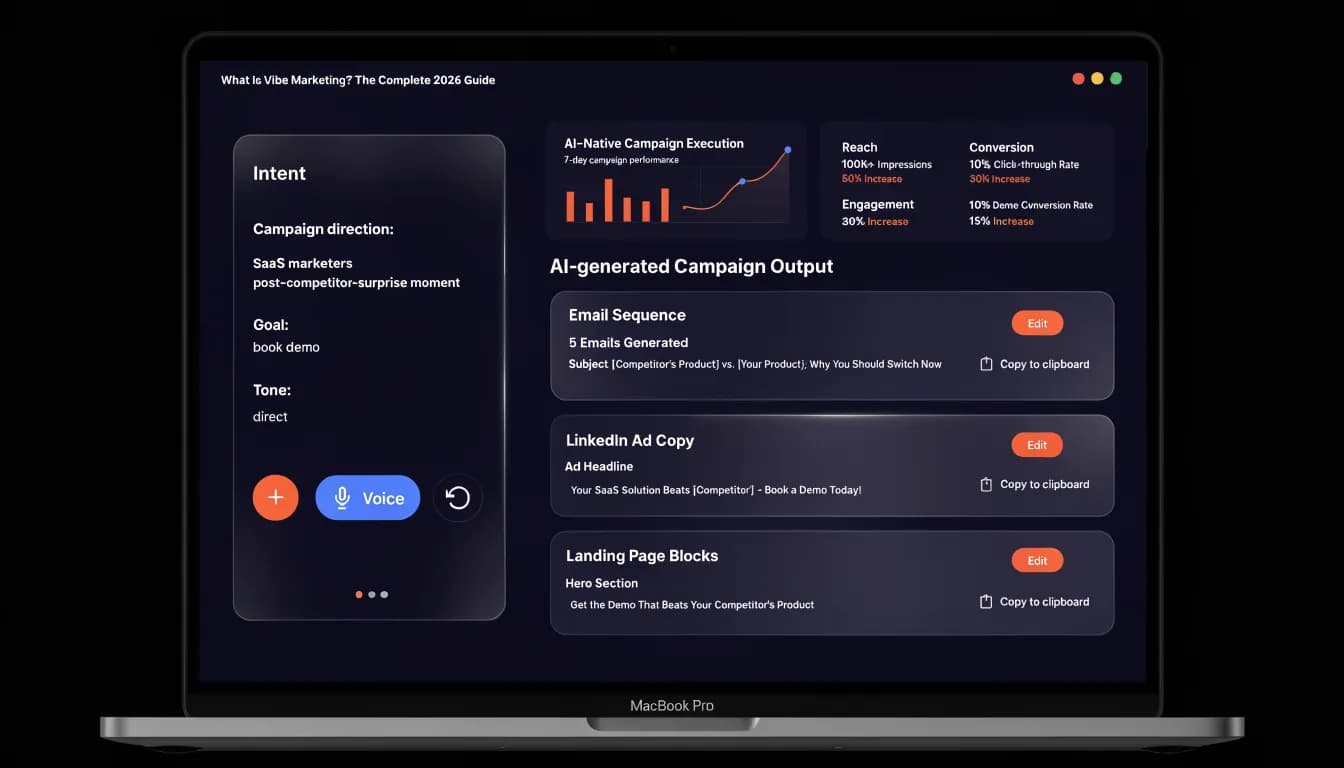
Same task, vibe marketing approach. You describe four things to your AI marketing platform:
- Who — “SaaS marketing managers at companies with 10–100 employees who’ve tried ChatGPT for marketing and hit the context ceiling”
- What moment — “They just saw a competitor do something with AI that surprised them; they’re wondering if they’re falling behind”
- Goal — “Book a demo; they need to feel like we understand their specific problem, not AI in general”
- Tone — “Direct. No hype. We’ve been in this space for two years; we have receipts”
From that context, the system builds the campaign: landing page copy, email sequence, LinkedIn ads, retargeting angle. You review the output. You push back: “The LinkedIn ad is too feature-led; make it about the feeling of watching competitors ship faster.” The AI adjusts. You approve.
Total: hours, not days. One session. No handoffs.
The gap between these two workflows is not about the quality of the writing. It is about where human judgment goes. In vibe marketing, your time goes to direction and evaluation — the parts only you can do. In traditional marketing, your time goes to execution, coordination, and waiting.
Vibe Marketing vs. Traditional Digital Marketing
Traditional Marketing | Vibe Marketing | |
|---|---|---|
Brief to publish | 3–5 days | Same session |
Tools required | 4–6 specialized tools | 1 AI platform |
Technical skill | Moderate | Prompt fluency |
Campaign scale | Linear | Parallel/agentic |
Team size needed | 3–5 people | 1 person + AI |
Where your time goes | Execution | Direction + evaluation |
The skills that matter in a vibe workflow are different. You need to be fast at evaluating output quality — not just whether it is grammatically correct, but whether it would actually move the audience you are targeting. You need to recognize when the AI has the right direction but the wrong tone. You need to know when to push back and when to ship.
That is closer to creative direction than copywriting. Senior marketers tend to do it better than junior ones — which is the opposite of what most “AI replaces junior jobs” coverage assumes.
Vibe Marketing vs. Agentic Marketing — What Is the Difference?
These two terms are frequently used interchangeably. They are related but not the same thing.
Vibe marketing is a philosophy and working method. It describes how you approach your marketing work: leading with intent, directing AI through context, iterating on output rather than planning everything upfront. It is an AI-first mindset applied to the full marketing function.
Agentic marketing is an architecture. It describes AI systems that execute tasks autonomously — researching, creating, publishing, optimizing — with minimal or zero human involvement in each execution step. Agentic AI acts; it does not just generate.
The two concepts are partners. Vibe marketing describes how you work. Agentic marketing describes how the AI executes on your behalf. A platform built for vibe marketing has agentic capabilities underneath — it needs to be able to act, not just respond.
Most marketing AI tools are neither. They are generation tools: you ask, they produce text, you copy it somewhere else. That is not agentic, and it requires too much manual execution to qualify as vibe marketing in practice.
Allable sits at the intersection of both: an agentic marketing platform you direct through intent (vibe marketing), powered by AI that executes campaigns across SEO, content, and competitive intelligence autonomously (agentic marketing).
The Vibe Marketing Tool Stack in 2026
There are now two categories of tools people use for vibe marketing, and they serve very different users.
Dev-First Agentic Tools (Powerful, Steep Learning Curve)
Tools like Cursor, n8n, Claude Code, and Dify give you the raw power to build any marketing automation you can imagine. Teams searching for the best AI for vibe coding often start here — powerful workflows, steep setup curve. If you know how to set up a workflow in n8n, you can connect your CMS, your keyword database, your CRM, and your publishing pipeline into a single automated system.
The catch: you need to be technical, or you need a developer. Setup takes days to weeks. Maintenance is ongoing. For most marketing teams, that dependency is not removable.
These tools are not marketing-native. They are infrastructure tools that marketers have adapted. For vibe coding for marketers who would rather ship campaigns than configure pipelines, the next category is the answer.
Marketing-Native Platforms (Built for This Workflow)
Newer and smaller, these platforms build the agentic capability directly into a marketing-focused product. You get the power of n8n-style automation without writing a single workflow rule.
Tool | Setup Time | Marketing-Specific | Monthly Cost | Technical Knowledge | Verdict |
|---|---|---|---|---|---|
n8n | Days–weeks | ❌ (general automation) | $20–$50+ | Developer required | Powerful but not for most teams |
Make.com | Hours–days | ❌ (general automation) | $9–$99+ | Moderate technical | Better UX, same dev dependency |
Cursor | Hours | ❌ (coding-focused) | $20 | Developer required | Wrong tool for marketing |
Jasper | Minutes | ✅ (content only) | $49–$125 | None | Content-only, not agentic |
Copy.ai | Minutes | ✅ (GTM workflows) | $36–$186 | None | Closer to vibe, limited channels |
Allable | 5 minutes | ✅ (full marketing stack) | Competitive | None | Built for this use case |
The distinction that matters for vibe marketing: does the tool hold your context across sessions, or do you start from scratch every time? Does it connect SEO, content, campaigns, and analytics in one place, or do you still need five tabs open?
AI content creation and content marketing strategy tools have made significant progress here, but most remain single-function. The vibe marketing workflow requires cross-function coherence.
Vibe Marketing Examples in 2026
Klaviyo K:AI — Autonomous Email Sequences
Klaviyo’s K:AI feature launched in late 2025 with the explicit goal of letting marketers describe a campaign intent and have AI build the full email sequence — segmentation, copy, send timing, A/B variants. Klaviyo reported a 60–70% reduction in time from brief to live campaign for early adopters. This is vibe marketing applied to email automation.
Copy.ai GTM Agent Workflows
Copy.ai repositioned in 2025 around “GTM AI” — the idea that go-to-market work (prospecting, outreach, content, enablement) could be handled by AI agents directed by marketers through natural-language instructions. Their workflows connect CRM data, content generation, and outreach sequences without manual handoffs.
Allable for SEO Campaign Execution
A two-person marketing team at a SaaS company describes a keyword cluster to Allable: target audience, competitive positioning, content angle, publish cadence. Allable produces a cluster architecture with pillar and spoke structure, generates article outlines, flags Jasper alternatives and competitive gaps, and queues everything for writing and publishing. The team reviews once, approves the architecture, and tracks progress through the built-in audit tools. What used to take 3 weeks of planning takes one session.
How to Start with Vibe Marketing (Even Without a Dev Team)
Step 1: Audit which tasks still require manual copy-paste between tools
List every marketing task that requires you to export from one tool and import to another, or manually carry context from one conversation to the next. These are your vibe marketing candidates — the tasks where a context-aware AI system would eliminate the friction.
Step 2: Pick one workflow to convert
Do not try to change everything at once. Start with one repeating workflow — weekly social content, monthly email nurture, new landing page per campaign. Convert it to a vibe-led process: describe direction, review output, iterate.
Step 3: Document your context once
Write down what the AI needs to know: your brand voice, your ICP, your offer, your main competitors, your content rules. This becomes the context layer that powers every future interaction — and the foundation of a coherent vibe marketing strategy. Without it, you are starting from zero every time, which is slow and inconsistent.
Step 4: Measure before you scale
Speed is real. But if you are shipping 5× more content without tracking what works, you are producing volume, not results. Set a measurement baseline before you scale. Track: did output quality stay the same while speed increased? That is your signal to scale.
Step 5: Choose tools that hold context
If your AI tool forgets your brand between sessions, you are doing prompt-assisted typing, not vibe marketing. Choose a system built to maintain context across campaigns, channels, and time. This is one of the clearest differentiators between marketing automation alternatives and marketing-native vibe platforms.
Common Mistakes Teams Make with Vibe Marketing
Treating it like better prompting. Vibe marketing is not about writing longer or smarter prompts. It is about building a context layer and directing execution at the campaign level — not the sentence level.
Skipping the evaluation step. AI output needs your judgment. Teams that ship without reviewing assume the AI is always right. The vibe marketer’s actual job is to catch what the AI misses: wrong tone, weak angle, missed audience signal.
Using the wrong tools. General-purpose AI will not give you vibe marketing. You need a system with persistent context, cross-channel coherence, and marketing-specific capabilities. Using ChatGPT for vibe marketing is like using a spreadsheet for project management — it works until it does not.
Moving too fast without measurement. Speed is the benefit. But speed without signal is just faster noise. Set your measurement layer before you scale.
FAQ — Vibe Marketing Questions
What is the difference between vibe marketing and content marketing?
Content marketing is a channel strategy: you create valuable content to attract and convert an audience. Vibe marketing is a working method: you direct AI through intent to execute marketing work faster. The two are not in conflict. You can do content marketing using a vibe marketing approach — and most teams doing vibe marketing are doing exactly that.
Is vibe marketing just AI marketing with a new name?
Not exactly. AI marketing is a broad term covering any use of AI in marketing — from predictive analytics to ad targeting to personalization engines. Vibe marketing is a specific workflow philosophy: lead with intent, let AI execute, iterate on output. It is a subset of AI marketing, but the working method is distinct.
What tools do I need to start vibe marketing?
At minimum: a marketing AI platform with persistent context (so it remembers your brand across sessions) and cross-channel execution capability (so it connects content, SEO, and campaigns without manual handoffs). Most single-function AI content tools do not meet this bar. Purpose-built platforms built for this workflow are the better fit.
Can small teams do vibe marketing without developers?
Yes — and small teams often see the biggest leverage. A two-person marketing team using a vibe platform can produce the output volume of a five-to-six-person team running traditional workflows. The key requirement is not team size but marketing judgment: someone who can evaluate output quality fast and push back when the direction is wrong.
What is the difference between vibe marketing and prompt engineering?
Prompt engineering is about crafting precise instructions to get better AI output from a single task. Vibe marketing is about building a context layer and directing AI at the campaign or workflow level — multiple tasks, multiple channels, coherent strategy. One optimizes a single output. The other runs an entire marketing system.
Is vibe marketing a trend or a permanent shift?
The working method is permanent. The name may evolve. The underlying shift — from manual execution to AI-directed execution, with human judgment at the strategic layer — is structural. Teams that build this capability now will have a compounding advantage. It is not a trend to watch. It is a capability to develop.
What Comes Next
The definition of vibe marketing will keep splitting as the technology evolves. Teams doing it well are already building institutional knowledge: the ability to describe direction precisely, evaluate AI output critically, and iterate fast enough to outpace teams still doing everything manually.
Your competitors who build that judgment now will be harder to catch in 18 months. The question is not whether vibe marketing is real. The question is whether your current tools and workflow actually support it — or whether you are calling prompt-assisted typing “vibe marketing” and wondering why the results are inconsistent.
If you want to see what a marketing-native vibe platform looks like in practice, try Allable.ai — built specifically for this kind of marketing, 0 dev setup required.