Perplexity vs ChatGPT (2026): Which AI Tool Should You Actually Use?
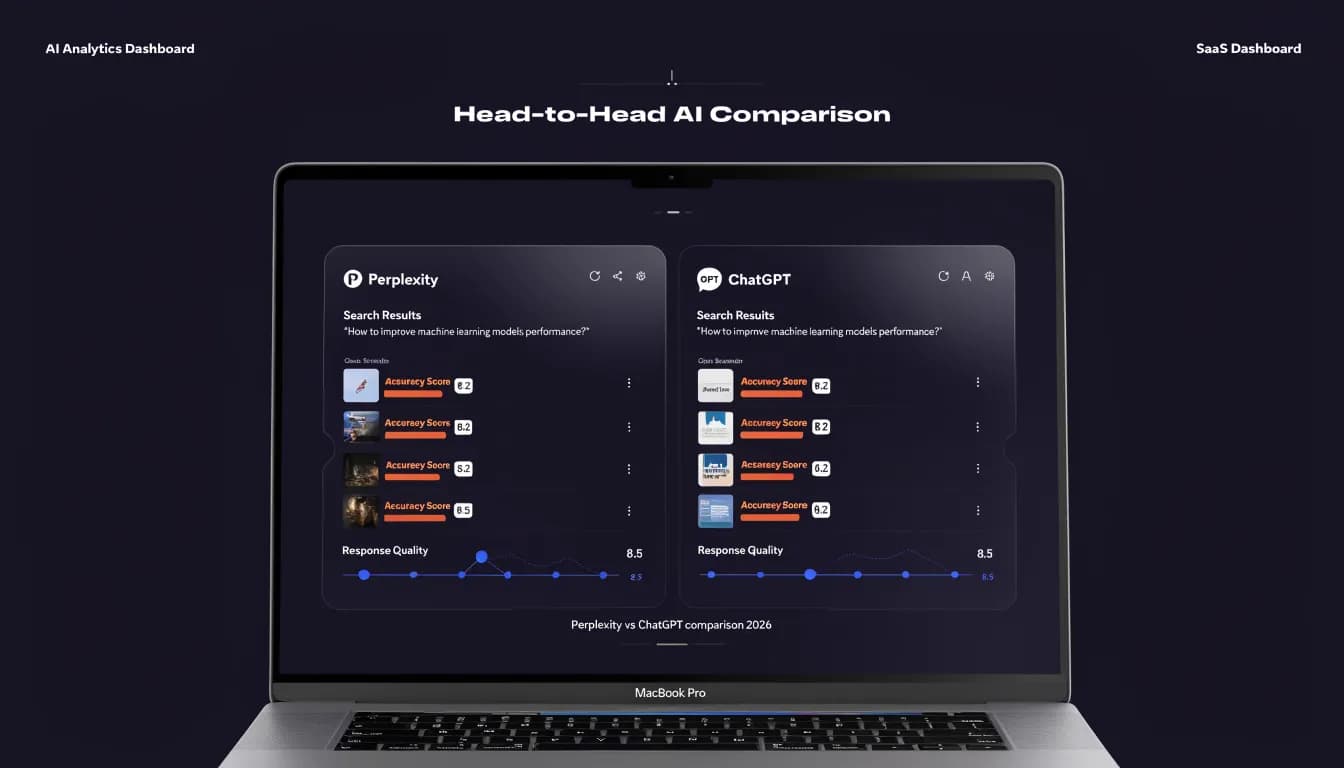
ChatGPT and Perplexity look identical from the outside — type a question, get an answer. But they're built on completely different principles, and using the wrong one for the wrong task costs you more than just time. Most people pay $20/month for whichever one they tried first. Is that you?
Your research workflow has a reliability problem you probably haven't measured yet. Every time you ask ChatGPT for a statistic, a competitor pricing update, or a recent industry report, you're betting that its training data captured it — and that nothing has changed since. That bet fails more often than the fluent, confident answers make it seem. Meanwhile, there's a different tool that pulls live sources, cites every claim, and runs on the same underlying models. Most people dismiss it as "just search." It's not.
Perplexity AI and ChatGPT look similar from the outside. You type a question, you get an answer. But they're built around completely different principles — one is an AI search engine that grounds every answer in verifiable sources, the other is a generative assistant that reasons and creates. Confusing the two doesn't just mean using the wrong tool. It means trusting outputs you shouldn't, and dismissing ones you should.
Most people end up paying $20/month for whichever one they tried first. That's usually the wrong one.
Perplexity vs ChatGPT — The 30-Second Answer
If you need one quick decision framework before reading further:
Task | Better tool |
|---|---|
Research with cited, verifiable sources | Perplexity |
Writing, coding, long-form content | ChatGPT |
Best free option | Both are strong — test both |
Teams and businesses | ChatGPT Business ($20/user/mo annual) or Perplexity Enterprise ($40/user/mo) |
The core difference is architectural. Perplexity is a retrieval-augmented generation (RAG) system — it searches the live web first, then synthesizes an answer from what it finds. ChatGPT is a generative model — it reasons and creates from its training data, with optional web browsing as an add-on.
That distinction shapes every feature, every limitation, and every use case below.
What Is Perplexity AI?
Perplexity launched in 2022 as an AI-native search engine with one core promise: give you a direct answer with sources you can check. By 2026, it has grown into a full research platform — but it has stayed true to that original premise.
How Perplexity Works
Every Perplexity query triggers a live web search first. The model synthesizes what it finds, then attaches numbered citations to every factual claim. You can click any citation to verify the source — a workflow that's baked into the interface, not bolted on.
This makes Perplexity fundamentally different from ChatGPT even when ChatGPT has web browsing enabled. ChatGPT uses Bing's index with a delay; Perplexity maintains its own real-time web index, updated continuously. In independent benchmarks on real-time factual queries, Perplexity consistently outperforms ChatGPT without browsing — and matches or exceeds ChatGPT Plus with browsing for time-sensitive tasks. The citation layer is what really separates them: every claim is numbered and clickable, making errors visible rather than hidden.
Perplexity Pro Features
The Pro tier ($20/month, or $17/month on an annual plan) unlocks:
- 300+ Pro Searches per day — the most thorough research mode, using advanced models
- Model switching — choose between GPT-4o, Claude 3.5 Sonnet, Gemini 1.5 Pro, and Perplexity's own Sonar reasoning models
- Deep Research — multi-step research mode that runs extended searches across dozens of sources before synthesizing
- File uploads — analyze PDFs, audio, and video files up to 40MB
- Image generation — DALL-E-powered image creation
- Spaces — organized research workspaces you can share with a team
- Perplexity Pages — turns any research thread into a shareable, structured document
That last feature is worth noting: Pages means Perplexity has entered content creation territory. It's not a full writing tool, but it narrows the gap with ChatGPT more than most comparisons acknowledge.
Perplexity Pricing (2026)
Plan | Price | Best for |
|---|---|---|
Free | $0 | 5 Pro Searches/day, unlimited basic search |
Pro | $20/mo ($17/mo annual) | 300+ Pro Searches, model switching, files |
Max | $200/mo ($167/mo annual) | Unlimited everything, advanced reasoning models |
Education Pro | $5/mo | .edu email — full Pro features |
Enterprise Pro | $40/user/mo | Teams, data privacy, admin controls |
Enterprise Max | $325/user/mo | Large orgs, advanced security |
Perplexity's Key Limitation
Perplexity is not a writing tool. Ask it to draft a 1,000-word blog post and you'll get competent but flat prose — more research summary than finished content. Long-form writing, structured arguments, code generation — these are areas where ChatGPT's generative architecture has a clear structural advantage.
What Is ChatGPT?
ChatGPT crossed 400 million weekly active users in April 2026. It's the most-used AI product on Earth, and in 2026 it's significantly more capable than the version that dominated most comparisons written a year ago.
GPT-4o, o3, and the Current Model Landscape
The default model for most ChatGPT users is GPT-4o — fast, capable, and available on the free tier in limited form. Plus subscribers get full access to GPT-4o with no rate limits, plus OpenAI's reasoning models (o1 and o3) for complex multi-step tasks. The o3 model's chain-of-thought reasoning produces noticeably better results on technical and analytical questions.
For most marketing tasks — content writing, campaign planning, data analysis, creative brainstorming — GPT-4o on Plus is the relevant benchmark. Higher Pro tiers add Deep Research sessions (50/month) and extended context for power users.
ChatGPT's Core Strengths
- Writing and content creation: long-form blog posts, ad copy, email sequences, landing pages — ChatGPT's generative model excels in ways Perplexity doesn't approach
- Code generation: debugging, writing scripts, explaining code logic — consistently stronger than Perplexity
- File analysis: accepts files up to 512MB (vs Perplexity's 40MB), covering DOCX, PDF, PPTX, CSV, XLSX
- Custom GPTs: build specialized assistants for specific workflows
- Multi-turn reasoning: better at maintaining context across long conversations and refining outputs iteratively
- Canvas interface: collaborative writing and editing workspace
ChatGPT Pricing (2026)
Plan | Price | Best for |
|---|---|---|
Free | $0 | GPT-4o mini, basic features |
Plus | $20/mo | GPT-4o + o3, full tool access, higher rate limits |
Pro | $100–200/mo | 50–unlimited Deep Research sessions, extended o3 |
Business | $20/user/mo (annual) | Teams, data privacy, admin tools |
Enterprise | Custom (150+ users) | Large organizations |
ChatGPT's Key Limitation
Without web browsing enabled, ChatGPT answers from its training data — which has a cutoff date and doesn't know what happened last week. Even with browsing enabled, it's less reliable than Perplexity for time-sensitive queries because it uses an external search index with a delay rather than a live proprietary index.
The other limitation is hallucination confidence. ChatGPT can generate a plausible-sounding statistic or citation that doesn't exist. It does this less often than older models, but it still does it — and the confident delivery makes it harder to notice.
Head-to-Head: 5 Key Differences
1. Research and Fact-Finding: Perplexity Wins
For any query where the answer depends on recent events, current pricing, live data, or source verification, Perplexity is the better tool. Its real-time index and citation layer translate directly to fewer errors you have to catch and correct.
The citation interface changes your workflow. With Perplexity, verifying a claim takes one click. With ChatGPT, you need to Google the claim yourself or explicitly ask it to find a source — and then verify that the source is real.
2. Writing and Content Creation: ChatGPT Wins
Ask both tools to write a 1,000-word product landing page, a 5-email nurture sequence, or a blog post introduction. ChatGPT's output will be more polished, better structured, and require fewer edits. This isn't a small difference in the context of a real content workload.
Perplexity's Pages feature has closed the gap somewhat for research-backed documents. But for anything requiring voice, creativity, or persuasion, ChatGPT is the clearer choice.
3. Citations and Source Reliability: Perplexity Wins
Perplexity cites every answer. ChatGPT (on the free plan) cites nothing. ChatGPT Plus with browsing cites some claims — but inconsistently, and the sources aren't always accessible or accurate. If your work involves claims that need to hold up to scrutiny, Perplexity's citation layer is a meaningful advantage.
One caveat: Perplexity's citations aren't infallible. The model can misread or misrepresent a source, especially on complex topics. Always check the primary source for anything critical.
4. Coding and Technical Tasks: ChatGPT Wins
ChatGPT is significantly better at writing code, debugging, and explaining technical concepts. Perplexity can answer coding questions but lacks the iterative problem-solving capability that makes ChatGPT useful for actual development work. For marketing tasks involving spreadsheet formulas, tracking scripts, or automation logic, ChatGPT is the right tool.
5. Competitive and Market Research: Perplexity Wins
"What did [competitor] change their pricing to last month?" "What are industry benchmarks for email open rates in 2026?" These are Perplexity questions. ChatGPT will attempt an answer from memory and may be months out of date without you knowing it.
Real Use Case Tests (Marketing Focus)
"Find me stats on email marketing open rates for 2026"
Perplexity: Returns a synthesized answer citing three sources — a Mailchimp benchmark report, a Campaign Monitor industry study, and a recent HubSpot blog post. All are clickable. The numbers are current.
ChatGPT (no browsing): Returns a plausible statistic from its training data. The number sounds right but is from 2024 benchmarks. You won't know this without checking separately.
Winner: Perplexity — not close.
"Write a 500-word landing page for a B2B SaaS product"
Perplexity: Produces a competent draft that reads more like a structured summary than marketing copy — lacks the persuasive hook that converts visitors.
ChatGPT: Produces polished, structured copy with a clear headline, benefit-led sections, and a CTA. Needs editing but is closer to usable from the first draft.
Winner: ChatGPT — clearly.
"What are my top competitors' recent pricing changes?"
Perplexity: Searches live sources, returns current pricing with publication dates. If a change happened last week, it will usually appear.
ChatGPT: Answers from training data. If pricing changed after its cutoff, the answer will be confidently wrong.
Winner: Perplexity.
"Summarize this 30-page market research PDF"
Perplexity: Handles it. Accepts files up to 40MB, summarizes well with citations back to page content.
ChatGPT: Also handles it — accepts larger files (up to 512MB), with better multi-turn follow-up capability for complex document analysis.
Winner: ChatGPT — slightly better for complex document workflows.
Pricing Comparison (2026)
Both tools start free, both charge $20/month for their primary individual plan, and both have enterprise options. The plans are priced identically at the mid tier — the difference is in what you get.
Tier | Perplexity | ChatGPT |
|---|---|---|
Free | Unlimited basic search, 5 Pro Searches/day | GPT-4o mini, limited features |
Individual paid | Pro — $20/mo | Plus — $20/mo |
Power user | Max — $200/mo | Pro — $100 or $200/mo |
Teams | Enterprise Pro — $40/user/mo | Business — $20/user/mo (annual) |
Enterprise | Enterprise Max — $325/user/mo | Custom (150+ seats) |
The practical takeaway: For individual use, both cost the same at the main paid tier. ChatGPT Business is meaningfully cheaper per seat than Perplexity Enterprise Pro ($20 vs $40/user/mo) — important if you're evaluating this for a team.
Both free tiers are genuinely useful. Test both before paying for either.
Which Tool Should You Use?
The answer depends on what most of your AI time is spent doing.
Choose Perplexity if:
- Research and fact-finding is a core part of your daily work
- You need cited, verifiable sources — for journalism, academic work, or claim-heavy content
- You're tracking competitor changes, pricing updates, or industry news in real time
- You want to access multiple AI models (GPT-4o, Claude 3.5 Sonnet, Gemini 1.5 Pro) from one search interface
Choose ChatGPT if:
- You write content, copy, or code daily
- You work with large document files (presentations, spreadsheets, long PDFs)
- You need iterative, multi-turn reasoning — building on previous answers in a conversation
- You want Custom GPTs for specialized, repeatable workflows
- Your team needs collaboration features at a reasonable per-seat cost ($20/user/mo on Business)
Use both if:
- You're a marketer or content creator who does both research and writing
- Your work requires both verified facts AND polished output — use Perplexity to gather, ChatGPT to write
- You run regular evaluations and want a real-time research layer alongside a generative assistant
What about Claude and Gemini?
If you're comparing across all major tools — Perplexity vs ChatGPT vs Claude or Perplexity vs ChatGPT vs Gemini — the short answer: Claude 3.5 Sonnet is the strongest writer of the group (sharper prose, better instruction-following). Gemini 1.5 Pro is best for Google Workspace integration and large-document analysis. Neither replaces Perplexity's real-time citation model for research tasks. For a full breakdown including Grok vs ChatGPT and apps like ChatGPT, the comparison hub covers them all.
The most effective workflow many professionals use in 2026: Perplexity for AI-powered research and source-gathering, ChatGPT for drafting and refining. The two tools are genuinely complementary — not competing for the same job.
If you want to explore other options, the best ChatGPT alternatives guide covers seven tools that fill different gaps, and our Claude vs ChatGPT breakdown is the most detailed head-to-head in this cluster.
The Third Option: AI Built for Marketing
Here's the limitation neither Perplexity nor ChatGPT solves on its own: they're general-purpose tools. Using them for marketing means stitching together research in Perplexity, writing in ChatGPT, SEO analysis in a separate tool, and campaign management in another. Each handoff costs time and context.
Allable is built around that specific problem. It combines AI-powered research, content writing, SEO keyword analysis, campaign planning, and competitor intelligence in a single platform — designed for marketing teams that need all of those capabilities without managing five separate subscriptions.
If you're spending more than a few hours a week moving between tools, it's worth a look. The free trial is at studio.allable.ai.
Frequently Asked Questions
What is Perplexity AI?
Perplexity AI is an AI-powered search engine that answers questions by searching the live web in real time and citing every source. Unlike ChatGPT, which generates answers from its training data, Perplexity uses retrieval-augmented generation (RAG) — it finds current information first, then synthesizes it. The result is an answer with numbered citations you can click to verify. Available free at perplexity.ai, with a Pro tier at $20/month.
Is Perplexity AI better than ChatGPT?
For research and fact-finding with cited sources, yes — Perplexity is more reliable for current, verifiable information. For writing, coding, long-form content creation, and complex reasoning tasks, ChatGPT is the stronger tool. Most professionals who do both end up using both. The tools are complementary, not interchangeable.
Is Perplexity AI free to use?
Yes. Perplexity's free plan includes unlimited basic searches and 5 Pro Searches per day — enough for casual research. Pro ($20/month, or $17/month annually) removes the daily Pro Search cap, adds model switching (GPT-4o, Claude 3.5 Sonnet, Gemini 1.5 Pro), file uploads, and image generation. Students with a .edu email can get Pro for $5/month — one of the better student AI deals available.
Does Perplexity hallucinate less than ChatGPT?
Perplexity's citation system makes errors easier to catch — you can click the source to verify the claim immediately. ChatGPT can generate confident-sounding facts that don't exist, particularly for recent events beyond its training cutoff. Perplexity can also misread or misrepresent a source, especially on complex topics. Neither tool is 100% accurate. For high-stakes claims, always verify the primary source directly.
Can Perplexity replace Google?
For many research queries, yes — Perplexity synthesizes and cites better than Google's traditional link-based results. It doesn't replace Google for local search, image search, maps, or highly visual queries. For knowledge work and professional research, many users find Perplexity more efficient than both Google and ChatGPT.
Which is better for marketing: Perplexity or ChatGPT?
Use Perplexity for competitive research, fact-gathering, industry data, and anything that requires verified current sources. Use ChatGPT (or Allable) for content creation, ad copy, email sequences, and campaign planning. For a broader view, see our guide to AI tools for SEO or compare the top apps like ChatGPT side by side.
Martin Janeček is the CEO of Allable.ai, an all-in-one AI marketing platform. He writes about AI tools, SEO, and content strategy.